BILINGUAL SERVICES DELIVERY: AN INCREASING NEED
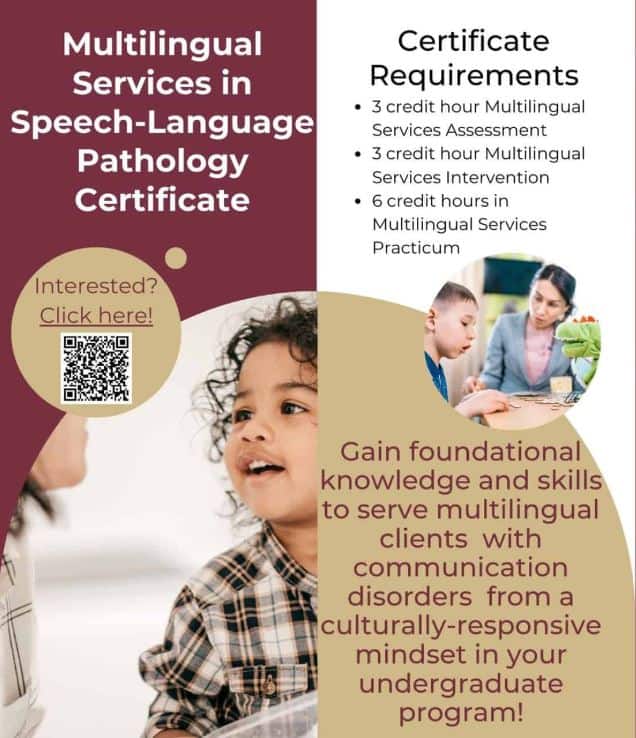
The FSU School of Communication Sciences & Disorders Bilingual Services in Speech Language Pathology Certificate program provides students with a foundation regarding bilingual development, assessment, and intervention for clients from historically marginalized racial/ethnic and linguistic backgrounds.
To address the needs of an increasingly diverse client population, speech-language pathologists are challenged to intensify language and literacy instruction and rehabilitation tailored to the language needs of clients with bilingual backgrounds. In 2018, a record 67.3 million U.S. residents spoke a language other than English at home. The number has more than doubled since 1990 and almost tripled since 1980 (Center for Immigration Studies, 2019). Additionally, bilingual learners (BLs) are one of the fastest growing student groups receiving language instruction in education programs with 48 million BLs across the country in 2016-2017. During the 2017-2018 school year, 11.2% of students with disabilities were BLs. ASHA’s Code of Ethics clearly describes speech-language pathologists’ responsibility in engaging life-long learning to provide evidence-based services for all clients, regardless of cultural and linguistic background.
To equip future speech-language pathologists to respond to current workplace demands, this certificate program will provide students with the foundational knowledge and skills needed to approach clinical practice with bilingual children and adults from an evidence-based mindset. These skills include assessment, treatment plan development, intervention, and plan implementation. The courses are constructed to provide the skills necessary to consume, conduct, and produce research as well as provide clinical service delivery with a focus on bilingual learners and users across the lifespan. All courses focus on topics related to a) cultural responsiveness/cultural sustainment, b) bilingual assessment, c) bilingual intervention, and (d) practicum opportunities in research and clinical contexts.
The certificate is designed for current undergraduate students and is open to CSD students. Students who complete the certificate will be able to:
- Understand the impact of personal-level and environmental-level factors on the experiences of bilingual speakers with communication disorders
- Explain the process for bilingual development and language recovery in bilingual users
- Identify and describe evidence-based approaches for assessing and intervening with bilingual children with communication disorders
- Identify and describe evidence-based approaches for assessing and intervening with bilingual adults with acquired communication disorders
- Apply knowledge of culturally responsive/sustaining practices in case-study and real-world application activities
Related News
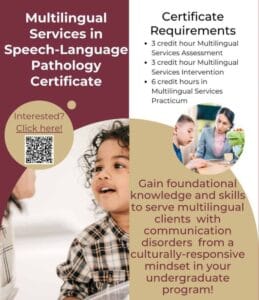
Certificate Requirements
Students seeking the certificate must satisfy 6 credit hours of coursework and 6 credit hours of practicum over 2 years with a minimum GPA of 3.0. All courses are electives in the School of Communication Science and Disorders. Students’ courses of study are approved by their academic advisors upon admission to the program.
See below for a list of required courses and when they are offered.
- SPA 4470: Bilingual Assessment in Speech Language Pathology
- (3 Credit Hours)
- Available in Fall
- SPA 4477: Bilingual Intervention in Speech Language Pathology
- 3 Credit Hours
- Available in Spring
- SPA 4946L Bilingual Practicum
- 6 Credit Hours
- Available in Fall and Spring
- *May be available during summer semesters upon request
Notes:
*SPA 4470 and SPA 4477 do not need to be taken in a particular order.
*You may take SPA 4946L for a minimum of 2 CHs across 3 semesters or a maximum of 3 CHs across 2 semesters.
*You may enroll in SPA 4946L while taking SPA 4470 OR SPA 4477 but this is not required. You may choose to complete the SPA 4470 and 4477 requirements first and then complete the SPA 4946L requirements.
Course Information
Bilingual Service Assessment in Speech-Language Pathology (SPA 4470)
The goal of this seminar is to equip students with the foundational knowledge and skills to be able to approach assessment of bilingual children and adults from an evidence-based mindset. Focus will be primarily on assessment for identification of communication disorders in bilingual speakers across the lifespan and treatment planning to facilitating language and literacy development/rehabilitation. Students will participate in class discussion, interact with scholarly material, and complete various application-based activities. Upon completion of this course, students will be able to identify and describe evidence-based approaches for assessing bilingual clients with communication disorders. Students will use the knowledge gained from the course to create a service project centered around improving services for bilingual adults. This course is a companion to Bilingual Service Intervention in Speech-Language Pathology.
Click here to view a sample syllabus!
Bilingual Service Intervention in Speech-Language Pathology
The goal of this seminar is to provide foundational knowledge on facilitating language and literacy outcomes of bilingual speakers across the lifespan. Focus will be primarily on practical, developmentally appropriate evidence-based intervention for bilingual children and adults with acquired communication disorders. Students will engage in class discussions about scholarly topics and complete various application-based activities to put their knowledge to the test. Upon completion of this course, students will be able to identify and describe evidence-based approaches for intervening with bilingual individuals with identified communication disorders and use the knowledge gained from the course to create a service project centered around improving services for bilingual individuals. This course is a companion to Bilingual Service Assessment in Speech-Language Pathology.
Click here to view a sample syllabus!
Bilingual Services Delivery Applied Clinical and Research Practicum
This course is a practical, hands-on discussion of current bilingual research and clinical practicum. This practicum is designed to help prepare students in the program to develop competencies with applied clinical research skills and research tools needed to provide evidence-based services to bilingual children and adults with communication disorders. It is designed to provide opportunities for direct exposure to, practice with, and feedback on the use of communication assessment tools, data management, and analysis; as well as planning and providing intervention in embedded activities and collaboration with individuals in the community. Students will receive guided practice embedded in community-based real-world contexts. Practicum experiences will support pre-service training of speech-language pathologists with specialized knowledge and skills in speech, language, and literacy needs of a high-need population. Specific projects will be selected by the student and instructor based on student interest and will have an emphasis on bilingual speakers.
Requirements
This program is open to degree-seeking undergraduate students who:
- Are a major of Communication Science and Disorders
- Have a minimum earned grade point average of 3.0 or higher on all undergraduate course work toward a bachelor’s degree
- Are currently enrolled as an undergraduate student in good standing at Florida State University
Application Procedure
Students MUST apply no later than after completion of their first course with a B or above or they will not be accepted to the Bilingual Services Delivery Certificate Program. We prefer that students apply prior to the 7th week of classes during the term of their first course applicable to the certificate requirements. We will notify the Registrar that the student has applied for participation in the Bilingual Services Delivery Certificate Program.
To earn a certificate, students must:
- Apply and be approved to pursue a certificate program no later than after completion of their first course required for a certificate.
- Complete the required number of credit hours of course work from the approved list of courses.
- Complete the required research and practicum component.
- Earn a grade of “B” or higher in each of the courses completed for a certificate.